Buyer and evaluator
Needs confidence that TrackLab is technically credible, commercially serious, and ready for utility-scale use.
- Clear system architecture
- Deployment and support model
- Proof of operational maturity

TrackLab documentation explains the technical architecture, controller roles, communications, monitoring, and commissioning model behind our solar tracking platform.
It is written for South African deployments first, with language and structure that also supports broader African and global evaluation.
The first version of the hub is tuned for technical buyers, partners, and operators who need a clear and credible explanation of the system before deeper engagement.
Needs confidence that TrackLab is technically credible, commercially serious, and ready for utility-scale use.
Needs to understand how TrackLab fits into field deployment, communications, and commissioning workflows.
Needs precise explanations of monitoring, site control, alerting, and field hardware responsibilities.
Use the technology hub to understand controller roles, field communication, and cloud visibility.
Review the TCU, NCU, monitoring, and commissioning guides for practical deployment context.
Use the architecture, communications, support, and specification pages to evaluate site fit.
Use the public guides as a shared starting point for a project-specific technical discussion.
Start with controller roles, system architecture, monitoring, communications, and commissioning to understand how TrackLab supports utility-scale solar tracker operation.
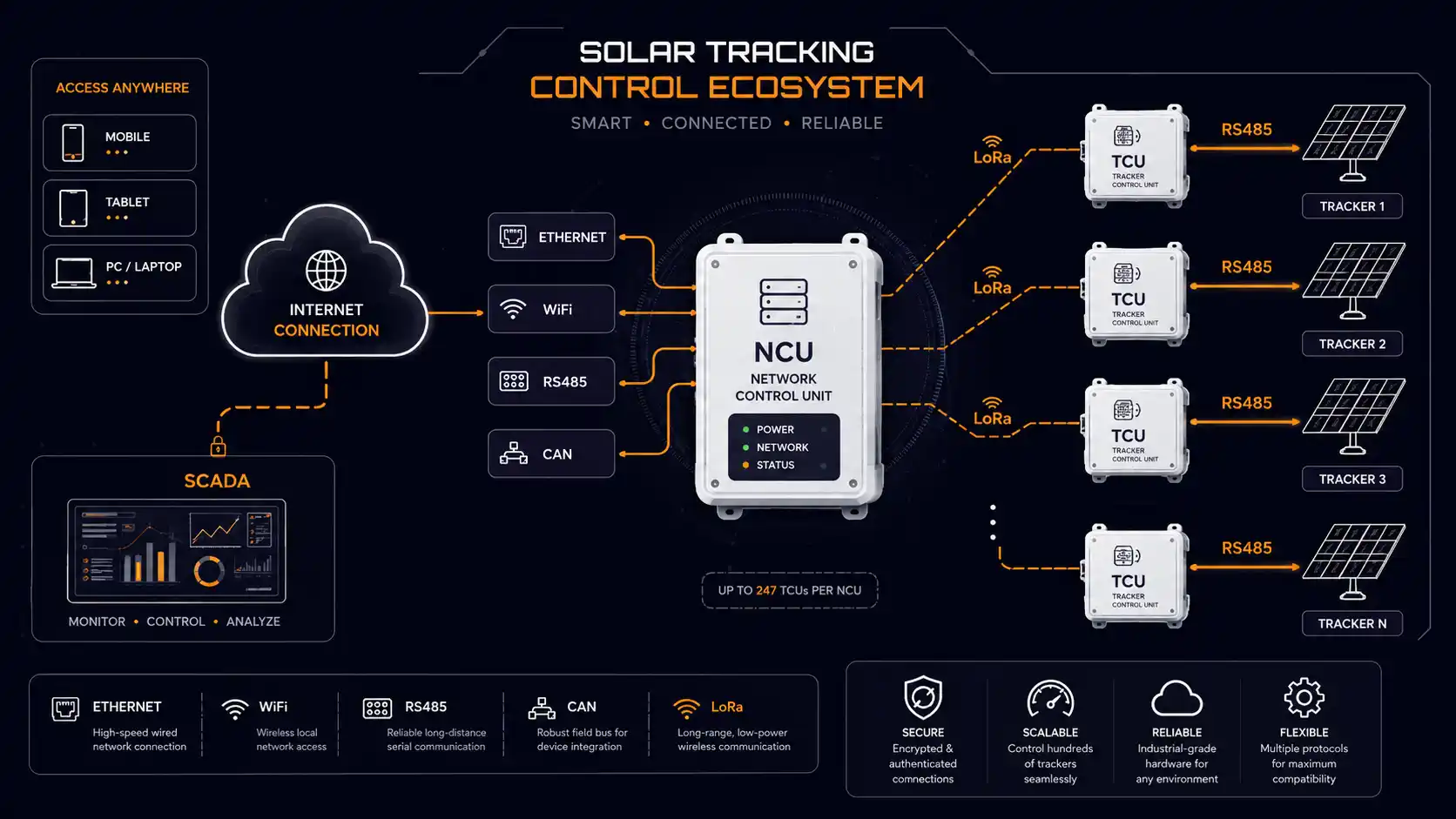
TrackLab connects field-level tracker control, site coordination, and cloud visibility into one solar tracking platform that can support technical evaluation and long-term operations.
Start here for the full field-to-cloud control model.
The TCU manages row-level tracker control, local inputs, and field reliability so operators can maintain predictable tracker behaviour in harsh outdoor environments.
Understand row-level control, local inputs, and field reliability.
The NCU coordinates communications, fleet-level visibility, and upstream connectivity between field devices and remote monitoring workflows.
Understand site coordination, gateway behaviour, and upstream connectivity.
TrackLab monitoring is designed to give operations teams a practical view of device state, exceptions, and reporting workflows that matter during live plant operations.
See how device state, exceptions, and reporting support live operations.
TrackLab supports field and upstream communications patterns needed for solar tracker deployments, including industrial device connectivity and remote platform integration.
Review field communications options and integration context.
TrackLab deployment guidance explains how a site moves from installation to bring-online, commissioning, and supported operation.
Review the commissioning flow and operational handover model.
The public documentation narrative should always anchor back to the same system model: field control, site coordination, operations visibility, and technical trust.
TCUs handle row-level sensing, movement logic, and device interaction close to the tracker.
NCUs connect device communications, site-level visibility, and upstream operational workflows.
Monitoring, reporting, and support workflows turn field data into usable operational decisions.
Public documentation, support framing, and technical explainers help buyers evaluate the system with confidence.
TrackLab connects field-level tracker control, site coordination, and cloud visibility into one solar tracking platform that can support technical evaluation and long-term operations.
The TCU manages row-level tracker control, local inputs, and field reliability so operators can maintain predictable tracker behaviour in harsh outdoor environments.
The NCU coordinates communications, fleet-level visibility, and upstream connectivity between field devices and remote monitoring workflows.
TrackLab monitoring is designed to give operations teams a practical view of device state, exceptions, and reporting workflows that matter during live plant operations.
TrackLab supports field and upstream communications patterns needed for solar tracker deployments, including industrial device connectivity and remote platform integration.
TrackLab deployment guidance explains how a site moves from installation to bring-online, commissioning, and supported operation.
The documentation hub supports, and is supported by, the rest of the public site. These pages provide complementary context for commercial and technical evaluation.
If you are evaluating solar tracker control systems for a South African or broader African deployment, TrackLab can provide architecture context, monitoring workflow guidance, and a technical review for your project team.